
Our lab gave one demo presentation at the international conference AVI 2026, held June 8–12, 2026.
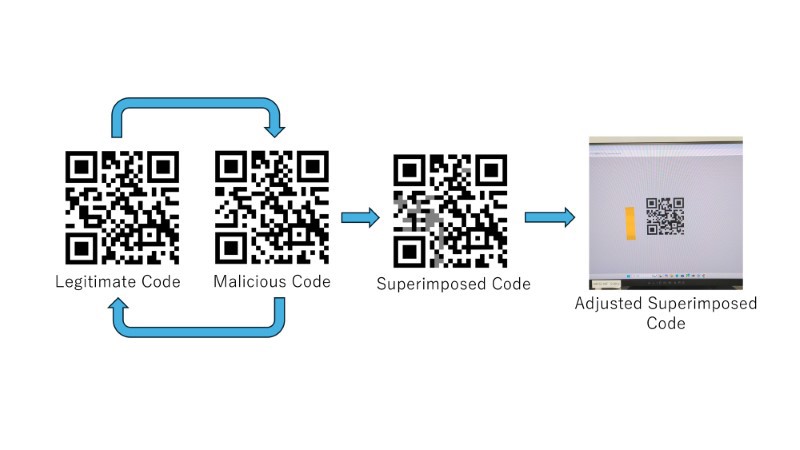
Our previously developed superimposed QR code attack, which exploits the difference between human visual perception and camera imaging characteristics, was originally proposed for LCD displays. However, on LCD displays, adjacent flickering dots produce a visible boundary that makes the attack easy to detect. This forced the modified dots to be spaced apart, severely limiting the number of dots that could be altered. As a result, the attack could only be applied to specific QR codes that could be redirected to different data by changing just a handful of dots.
In this work, to overcome this limitation, we developed a custom high-refresh-rate LED display that drives an LED panel module directly via a microcontroller, and applied the same technique to it. We found that on this display, adjacent flickering dots no longer produce a visible boundary. This allows the number and placement of modified dots to be changed flexibly, making it possible to carry out the attack against a wide variety of QR codes.
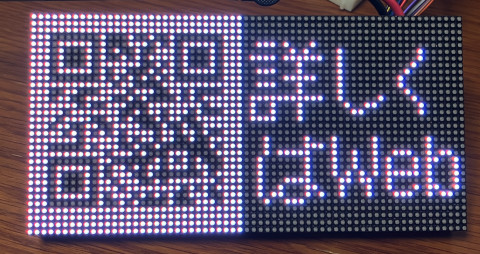
LED panel displaying a tampered QR code
Publications
- Demo: “Evaluating the Feasibility of Superposed QR Code Attacks Using High Refresh Rate Displays” Keita Suzuki, Kentaro Fukuchi, Proc. of Advanced Visual Interfaces 2026. DOI: 10.1145/3811427.3811506 (2026)