
Background
As computer games grow increasingly complex, the amount of information that new players must understand has also grown. This has made tutorials at the start of a game more important than ever.
Tutorials employ a variety of techniques to guide players’ attention toward interactive targets. Common examples include changing or flashing the color of a button, or using a “focus” effect that darkens the entire screen while leaving only the target area visible. Although such techniques are widely used, their effectiveness and the appropriate timing for presenting them have not been sufficiently studied.
The information a tutorial must convey can be broadly divided into two types. The first is positional information — which button to press. The second is semantic information — why that button is needed in this situation.
Presenting cues with strong visual guidance immediately draws players’ attention to the target, but this risks the explanatory text not being fully read before the action is completed. Conversely, weak guidance prolongs the search for the target and may cause frustration. Immediate positional understanding and comprehension of semantic information often stand in a trade-off relationship.
Experiment
We conducted an eye-tracking experiment combining two design factors: presentation method and presentation timing.
Presentation method (2 types):
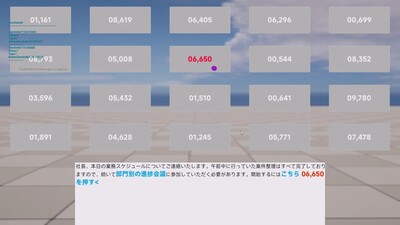
- Button color change: Changes the text color of the target button — a lightweight and easy-to-implement technique.
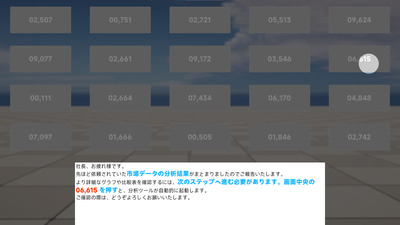
- Focus: Darkens the entire screen and leaves only the area around the target button bright, forcibly concentrating the player’s attention.
Presentation timing (2 types):
- During text display: Presentation begins the moment the button label appears within the scrolling tutorial text.
- After text display ends: Presentation begins only after the full text has finished displaying.
These factors were combined into four conditions, and eight university students (with valid data) participated in the experiment.
Results
In conditions where presentation began during the text display (both button color change and focus), gaze was first directed to the target button immediately after the cue appeared, and then returned to the text display area. This suggests that positional recognition and reading of the explanation can coexist.
In contrast, in conditions where presentation began after the text had finished, players started searching for the target button on their own from the moment the button label appeared in the text. This prolonged the search behavior and led to shorter gaze times on the text display area.
Regarding the difference between presentation methods, the focus technique produced more consistent gaze-guidance timing across participants, while button color change served as a lightweight cue that, despite some individual variation, was compatible with ongoing reading.
The results demonstrate that presentation timing has a greater effect on attention allocation than presentation intensity. Please refer to the paper for details.